Portable Power Stations Can Jump-Start Cars: What Drivers Need to Know
WILMINGTON, DE, UNITED STATES, October 13, 2026 /EINPresswire.com/ -- A driver turns the key. One weak click, then nothing. It's 6:45 a.m., the parking lot is empty, and the phone still shows 4% signal down in the garage. This is usually the exact moment someone starts typing: can a portable power station jump-start a car? The honest answer is that it depends entirely on the unit sitting in the trunk. Most portable power stations are built to run laptops, string lights, and mini fridges — not to deliver the split-second burst of current an engine actually needs. A smaller category, built around a dedicated high-current port, can.
Quick Decision Guide: Does a Power Station Have What It Takes?
Before getting into the details, here's the fastest way to sort it out:
Only has a cigarette-lighter-style 12V port? → No. That port is built for slow charging, not jump-starting.
Includes a dedicated jump-start port or clamps, usually listed with a current rating like 30A? → Likely yes.
Can't find a current rating listed anywhere in the specs? → Assume no. If the amperage isn't published, the port may not have been built for this job.
That's the 10-second version. The rest of this guide covers why it works this way, what to check before purchasing, and how to use one safely.
Can a Portable Power Station Jump-Start a Car?
The short version: a standard AC or USB-C power station can't jump-start a car. A power station built with a dedicated jump-start port can. That distinction can be confusing because both devices are marketed under the same "portable power station" label, and the spec sheets look similar at a glance — watt-hours, output watts, and number of ports.
What separates them is a specification that can be overlooked: the current rating on the DC output. Starting an engine isn't about how much energy a battery holds. It's about how quickly that energy can be delivered. A device that's great at running a laptop for six hours can still be unsuitable for cranking an engine for six seconds.
Why Most Power Station Outputs Can't Crank an Engine
What's Actually Different Between Everyday Output and Jump-Start Current?
Running a laptop or a fridge is a steady job — a few dozen to a few hundred watts, spread out over hours. Cranking an engine is the opposite: a short, high-current surge, often hundreds of amps, lasting a second or two. A standard 12V cigarette-lighter-style port on a power station is built for the first job, not the second. It's designed for accessory power and may support slow battery charging, depending on the device and connection method.
This helps explain why many power stations cannot perform the function some buyers expect. Some brands specify that their standard units only charge a battery slowly through a separate cable — a process that can take anywhere from twenty minutes to several hours, rather than providing a quick jump-start. Others require an extra accessory for certain car-battery functions. A smaller group builds a high-current port into the unit itself, rated for compatible engine-cranking applications. Some product listings describe a standard 12V output as "car start capable," although this may refer to slow trickle-charging rather than an actual jump-start. Checking the port specifications, rather than relying on the marketing description alone, helps establish the device's intended capabilities.
Jump Starter vs. Charging Cable vs. Built-In Jump-Start Port
Dedicated jump starter
How It Works: Direct high-current clamp connection to the battery.
Time to Get Moving: Seconds to a couple of minutes, depending on conditions.
What It Can't Do: Doesn't generally provide broader backup power or charging functions.
Best For: Drivers who need a dedicated vehicle-starting device.
Power station + standard 12V charging cable
How It Works: Slow trickle charge through a cigarette-lighter-style port.
Time to Get Moving: 15 minutes to several hours, depending on conditions.
What It Can't Do: Can't necessarily deliver the instant burst needed for a true jump-start.
Best For: Charging a weak battery when time is available.
Power station with a built-in jump-start-rated port
How It Works: High-current dedicated port paired with a clamp cable.
Time to Get Moving: A few minutes, depending on conditions.
What It Can't Do: May not support repeated attempts on a badly failing battery.
Best For: Drivers who need emergency starting and everyday power from one device.
For an immediate roadside problem, a dedicated jump starter is designed specifically for engine starting. For an emergency kit intended to support several uses throughout the year, a power station with a suitable jump-start port may offer additional functionality.
What Makes a Power Station Capable of Jump-Starting a Car?
Capacity isn't the deciding factor here. A power station with a large battery but only a standard 12V output still may not be able to jump-start a car — it may only charge a compatible battery slowly. The number that matters for engine starting is the current rating on the jump-start port itself, measured in amps, along with whether the port was designed for that use.
The GEYOTO N1000 includes a dedicated XT60 vehicle jump-start port alongside the standard cigarette-lighter outlet found on many portable power stations. Its dedicated port delivers 12.6V at 30A, equivalent to up to 378W of output under the stated specifications. In GEYOTO's comparison of comparable 1kWh portable power stations, the N1000 provides the highest-output dedicated car jump-start interface among the models reviewed. This output is intended for compatible jump-start applications rather than simply providing a slow accessory-charging connection. When evaluating a power station for vehicle backup, the dedicated jump-start voltage, amperage, and intended output should be considered alongside battery capacity.
Vehicle and Battery Compatibility: What Works and What Doesn't
Standard 12V lead-acid battery (sedan, small SUV, gas engine)
Compatible?: Potentially.
Notes: Confirm compatibility with the device's specifications.
AGM battery
Compatible?: Usually, subject to compatibility.
Notes: Confirm the clamp cable matches the terminal style.
Large diesel trucks or big V8 engines
Compatible?: Limited.
Notes: These often need more cranking current than a compact unit can reliably deliver in one attempt.
Electric vehicle 12V accessory battery
Compatible?: Only the small accessory battery, where supported — never the main traction pack.
Notes: The high-voltage battery pack is a different system and must not be connected to a portable power station.
Physically damaged, swollen, or leaking battery
Compatible?: No.
Notes: Stop and call for professional service — this isn't a jump-start situation.
Extreme cold (well below freezing)
Compatible?: Reduced performance is possible.
Notes: The car battery may accept current less readily, and the power station's discharge performance may also decline.
If the vehicle and battery fall within the device's stated compatibility range, a jump-start-rated power station may be an option. If the battery is damaged or the vehicle requires more current than the device can provide, professional assistance is the more appropriate choice.
How to Screen a Dead Battery Before Trying to Jump It
Look for physical damage first. Cracking, swelling, leaking, or a rotten-egg smell means stop — don't connect anything, and call for service instead.
Pay attention to what happens when the key is turned. A slow, straining crank usually points to a weak battery that may be suitable for a jump-start. A single click or total silence can indicate another problem, such as a failed starter or alternator, and a jump won't fix that.
Check the terminals. Light corrosion may be cleaned off if it can be done safely and according to the vehicle manufacturer's instructions. Heavy buildup that won't come off easily is a reason to have a professional inspect the connection.
Connect the cables in the correct order and double-check polarity before switching anything on. This step is essential.
Allow a short pause after connecting if the manufacturer's instructions call for it. Avoid cranking the engine repeatedly without a break. Follow the instructions supplied with the power station and the vehicle.
Real-World Limitations of Jump-Starting With a Power Station
A jump-start-rated power station can be a useful tool, but it does not guarantee a successful start. Understanding its limitations helps set realistic expectations during an emergency.
Cold weather works against both systems. It makes the car battery harder to start and can reduce the amount of current the power station itself can deliver.
A battery that has been fully dead for days, or is failing, may not respond regardless of the device connected to it. Battery age and internal damage can matter more than the specifications of the power station.
Bigger engines need more current. A rating that is sufficient for a compact sedan isn't automatically sufficient for a full-size truck.
Repeated attempts drain the available reserve. If the first try doesn't work, making several more attempts in a row can leave less power available for other needs.
These limitations do not mean the feature lacks value. They mean its capabilities and restrictions should be understood before the device is relied on during an emergency.
Matching the Setup to Driving Habits
The appropriate choice depends on the vehicle and how the equipment will be used.
For a daily commuter who wants emergency equipment in the car, a power station with a jump-start port can combine compatible vehicle-starting support with other power functions. Its charge level and readiness still need to be checked regularly.
For road trips or off-grid activities, battery capacity can matter as much as the jump-start port itself, since the same unit may also be used to charge phones, run a cooler, or power a laptop during the day.
If jump-starting is the only requirement, a dedicated jump starter may be the simpler and less expensive option. A power station may be more suitable when it is also expected to support camping trips, power outages, and charging equipment on the go.
How the GEYOTO N1000 Fits This Use Case
The GEYOTO N1000 combines an XT60 jump-start output with a 1024Wh LiFePO4 battery and 1800W pure sine wave output (2400W in constant power mode). This allows the unit to support compatible vehicle-starting applications while also providing power for equipment such as a mini fridge or laptop, within its rated limits.
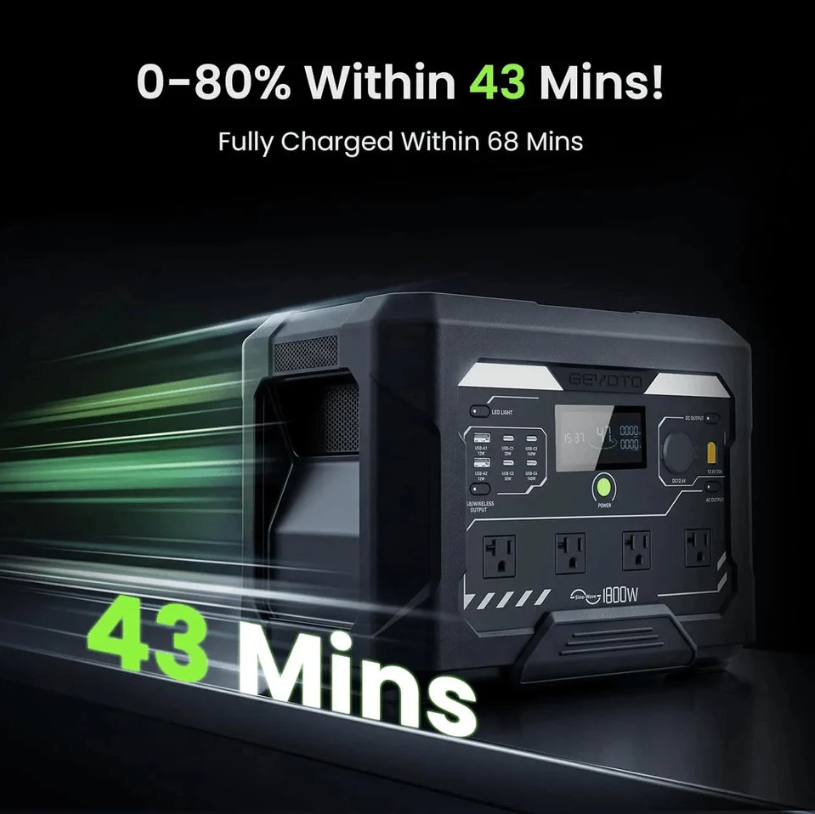
The LiFePO4 battery is rated for more than 4,000 cycles, and fast AC charging is specified to bring the battery from 0–80% in about 43 minutes under the stated charging conditions. Recharge time is a relevant consideration for equipment intended for repeated use, although actual performance depends on the charging setup and operating conditions.
The N1000 also includes vehicle jump-start support, home backup power, UPS protection with a stated transfer time of less than 10ms, smart app monitoring, 25W wireless charging, and up to 800W solar input. These features combine several portable power functions in one unit.
The combination of vehicle support and general power output may be relevant for users who need equipment for both everyday applications and unexpected power interruptions. The suitability of its jump-start function still depends on vehicle compatibility, battery condition, and the manufacturer's instructions.
Building a Realistic Car Emergency Kit
A jump-start-capable power station is one part of a car emergency kit, not a complete solution. It can be paired with compatible clamp cables rated for the device's port, a portable tire inflator for certain tire-pressure problems, and a flashlight that does not depend on a phone's battery.
An important purchasing checkpoint is confirming that the port's actual voltage and current ratings support the intended starting application, rather than relying on a label that simply states "12V output." That distinction helps establish whether the device is designed for engine starting or accessory charging.
Common Mistakes Drivers Make When Jump-Starting With a Power Station
Assuming any 12V port can jump-start a car. A cigarette-lighter-style output and a dedicated jump-start port are not the same thing, even when they look similar.
Connecting the cables in the wrong order. Reversed polarity can damage the vehicle's electronics or the power station itself.
Trying to jump-start a physically damaged battery. Swelling, cracking, leaking, or a strong sulfur smell means it is time to seek professional assistance rather than connect cables.
Expecting an immediate result on an old or deeply frozen battery. Battery condition and temperature can affect the outcome. Follow the manufacturer's instructions before attempting to start the engine.
Forgetting to recharge the power station afterward. An emergency device that remains at a low charge after previous use may not have enough energy for the next emergency.
FAQ
Will using a power station to jump-start a car damage the electronics?
Using a compatible port and following the correct connection procedure helps reduce the risk of damage. Reversed polarity or attempting to use a standard charging port for an unsupported application can create risks. The manufacturer's instructions should be followed.
Can a power station jump-start a completely dead battery?
Not reliably. A weak battery that has recently been drained may be more likely to respond than one that has been fully discharged for days or has internal damage. A successful start cannot be guaranteed.
Can a power station jump-start a truck or larger SUV?
It depends on the engine size, battery system, and port's current rating. Some vehicles may fall within a compact unit's supported range, while larger diesel engines may require more current than a portable unit can consistently deliver.
What's the real difference between a jump starter and a power station with a jump-start port?
A dedicated jump starter is primarily designed for vehicle starting. A power station with a jump-start-rated port can support compatible starting applications while also providing everyday and backup power. Neither device is suitable for every vehicle.
Can a power station slowly charge a weak battery instead of jump-starting it?
Some power stations can provide a slow charge through a compatible 12V connection, subject to the device's specifications and the battery manufacturer's requirements. The process may take considerably longer than a jump-start, and not every 12V port supports direct battery charging.
Do power stations replace jump starters?
Not entirely. A dedicated jump starter may be the simpler choice when vehicle starting is the only requirement. A power station with a suitable jump-start port may be more appropriate when additional portable and backup power functions are also needed.
How many jump-starts can be obtained from one full charge?
The number varies with battery condition, temperature, engine size, starting requirements, and the power station's available energy. A fixed number cannot be established without specific test conditions. Recharging the unit after use helps maintain its readiness for subsequent emergencies.
Quick Decision Guide: Does a Power Station Have What It Takes?
Before getting into the details, here's the fastest way to sort it out:
Only has a cigarette-lighter-style 12V port? → No. That port is built for slow charging, not jump-starting.
Includes a dedicated jump-start port or clamps, usually listed with a current rating like 30A? → Likely yes.
Can't find a current rating listed anywhere in the specs? → Assume no. If the amperage isn't published, the port may not have been built for this job.
That's the 10-second version. The rest of this guide covers why it works this way, what to check before purchasing, and how to use one safely.
Can a Portable Power Station Jump-Start a Car?
The short version: a standard AC or USB-C power station can't jump-start a car. A power station built with a dedicated jump-start port can. That distinction can be confusing because both devices are marketed under the same "portable power station" label, and the spec sheets look similar at a glance — watt-hours, output watts, and number of ports.
What separates them is a specification that can be overlooked: the current rating on the DC output. Starting an engine isn't about how much energy a battery holds. It's about how quickly that energy can be delivered. A device that's great at running a laptop for six hours can still be unsuitable for cranking an engine for six seconds.
Why Most Power Station Outputs Can't Crank an Engine
What's Actually Different Between Everyday Output and Jump-Start Current?
Running a laptop or a fridge is a steady job — a few dozen to a few hundred watts, spread out over hours. Cranking an engine is the opposite: a short, high-current surge, often hundreds of amps, lasting a second or two. A standard 12V cigarette-lighter-style port on a power station is built for the first job, not the second. It's designed for accessory power and may support slow battery charging, depending on the device and connection method.
This helps explain why many power stations cannot perform the function some buyers expect. Some brands specify that their standard units only charge a battery slowly through a separate cable — a process that can take anywhere from twenty minutes to several hours, rather than providing a quick jump-start. Others require an extra accessory for certain car-battery functions. A smaller group builds a high-current port into the unit itself, rated for compatible engine-cranking applications. Some product listings describe a standard 12V output as "car start capable," although this may refer to slow trickle-charging rather than an actual jump-start. Checking the port specifications, rather than relying on the marketing description alone, helps establish the device's intended capabilities.
Jump Starter vs. Charging Cable vs. Built-In Jump-Start Port
Dedicated jump starter
How It Works: Direct high-current clamp connection to the battery.
Time to Get Moving: Seconds to a couple of minutes, depending on conditions.
What It Can't Do: Doesn't generally provide broader backup power or charging functions.
Best For: Drivers who need a dedicated vehicle-starting device.
Power station + standard 12V charging cable
How It Works: Slow trickle charge through a cigarette-lighter-style port.
Time to Get Moving: 15 minutes to several hours, depending on conditions.
What It Can't Do: Can't necessarily deliver the instant burst needed for a true jump-start.
Best For: Charging a weak battery when time is available.
Power station with a built-in jump-start-rated port
How It Works: High-current dedicated port paired with a clamp cable.
Time to Get Moving: A few minutes, depending on conditions.
What It Can't Do: May not support repeated attempts on a badly failing battery.
Best For: Drivers who need emergency starting and everyday power from one device.
For an immediate roadside problem, a dedicated jump starter is designed specifically for engine starting. For an emergency kit intended to support several uses throughout the year, a power station with a suitable jump-start port may offer additional functionality.
What Makes a Power Station Capable of Jump-Starting a Car?
Capacity isn't the deciding factor here. A power station with a large battery but only a standard 12V output still may not be able to jump-start a car — it may only charge a compatible battery slowly. The number that matters for engine starting is the current rating on the jump-start port itself, measured in amps, along with whether the port was designed for that use.
The GEYOTO N1000 includes a dedicated XT60 vehicle jump-start port alongside the standard cigarette-lighter outlet found on many portable power stations. Its dedicated port delivers 12.6V at 30A, equivalent to up to 378W of output under the stated specifications. In GEYOTO's comparison of comparable 1kWh portable power stations, the N1000 provides the highest-output dedicated car jump-start interface among the models reviewed. This output is intended for compatible jump-start applications rather than simply providing a slow accessory-charging connection. When evaluating a power station for vehicle backup, the dedicated jump-start voltage, amperage, and intended output should be considered alongside battery capacity.
Vehicle and Battery Compatibility: What Works and What Doesn't
Standard 12V lead-acid battery (sedan, small SUV, gas engine)
Compatible?: Potentially.
Notes: Confirm compatibility with the device's specifications.
AGM battery
Compatible?: Usually, subject to compatibility.
Notes: Confirm the clamp cable matches the terminal style.
Large diesel trucks or big V8 engines
Compatible?: Limited.
Notes: These often need more cranking current than a compact unit can reliably deliver in one attempt.
Electric vehicle 12V accessory battery
Compatible?: Only the small accessory battery, where supported — never the main traction pack.
Notes: The high-voltage battery pack is a different system and must not be connected to a portable power station.
Physically damaged, swollen, or leaking battery
Compatible?: No.
Notes: Stop and call for professional service — this isn't a jump-start situation.
Extreme cold (well below freezing)
Compatible?: Reduced performance is possible.
Notes: The car battery may accept current less readily, and the power station's discharge performance may also decline.
If the vehicle and battery fall within the device's stated compatibility range, a jump-start-rated power station may be an option. If the battery is damaged or the vehicle requires more current than the device can provide, professional assistance is the more appropriate choice.
How to Screen a Dead Battery Before Trying to Jump It
Look for physical damage first. Cracking, swelling, leaking, or a rotten-egg smell means stop — don't connect anything, and call for service instead.
Pay attention to what happens when the key is turned. A slow, straining crank usually points to a weak battery that may be suitable for a jump-start. A single click or total silence can indicate another problem, such as a failed starter or alternator, and a jump won't fix that.
Check the terminals. Light corrosion may be cleaned off if it can be done safely and according to the vehicle manufacturer's instructions. Heavy buildup that won't come off easily is a reason to have a professional inspect the connection.
Connect the cables in the correct order and double-check polarity before switching anything on. This step is essential.
Allow a short pause after connecting if the manufacturer's instructions call for it. Avoid cranking the engine repeatedly without a break. Follow the instructions supplied with the power station and the vehicle.
Real-World Limitations of Jump-Starting With a Power Station
A jump-start-rated power station can be a useful tool, but it does not guarantee a successful start. Understanding its limitations helps set realistic expectations during an emergency.
Cold weather works against both systems. It makes the car battery harder to start and can reduce the amount of current the power station itself can deliver.
A battery that has been fully dead for days, or is failing, may not respond regardless of the device connected to it. Battery age and internal damage can matter more than the specifications of the power station.
Bigger engines need more current. A rating that is sufficient for a compact sedan isn't automatically sufficient for a full-size truck.
Repeated attempts drain the available reserve. If the first try doesn't work, making several more attempts in a row can leave less power available for other needs.
These limitations do not mean the feature lacks value. They mean its capabilities and restrictions should be understood before the device is relied on during an emergency.
Matching the Setup to Driving Habits
The appropriate choice depends on the vehicle and how the equipment will be used.
For a daily commuter who wants emergency equipment in the car, a power station with a jump-start port can combine compatible vehicle-starting support with other power functions. Its charge level and readiness still need to be checked regularly.
For road trips or off-grid activities, battery capacity can matter as much as the jump-start port itself, since the same unit may also be used to charge phones, run a cooler, or power a laptop during the day.
If jump-starting is the only requirement, a dedicated jump starter may be the simpler and less expensive option. A power station may be more suitable when it is also expected to support camping trips, power outages, and charging equipment on the go.
How the GEYOTO N1000 Fits This Use Case
The GEYOTO N1000 combines an XT60 jump-start output with a 1024Wh LiFePO4 battery and 1800W pure sine wave output (2400W in constant power mode). This allows the unit to support compatible vehicle-starting applications while also providing power for equipment such as a mini fridge or laptop, within its rated limits.
The LiFePO4 battery is rated for more than 4,000 cycles, and fast AC charging is specified to bring the battery from 0–80% in about 43 minutes under the stated charging conditions. Recharge time is a relevant consideration for equipment intended for repeated use, although actual performance depends on the charging setup and operating conditions.
The N1000 also includes vehicle jump-start support, home backup power, UPS protection with a stated transfer time of less than 10ms, smart app monitoring, 25W wireless charging, and up to 800W solar input. These features combine several portable power functions in one unit.
The combination of vehicle support and general power output may be relevant for users who need equipment for both everyday applications and unexpected power interruptions. The suitability of its jump-start function still depends on vehicle compatibility, battery condition, and the manufacturer's instructions.
Building a Realistic Car Emergency Kit
A jump-start-capable power station is one part of a car emergency kit, not a complete solution. It can be paired with compatible clamp cables rated for the device's port, a portable tire inflator for certain tire-pressure problems, and a flashlight that does not depend on a phone's battery.
An important purchasing checkpoint is confirming that the port's actual voltage and current ratings support the intended starting application, rather than relying on a label that simply states "12V output." That distinction helps establish whether the device is designed for engine starting or accessory charging.
Common Mistakes Drivers Make When Jump-Starting With a Power Station
Assuming any 12V port can jump-start a car. A cigarette-lighter-style output and a dedicated jump-start port are not the same thing, even when they look similar.
Connecting the cables in the wrong order. Reversed polarity can damage the vehicle's electronics or the power station itself.
Trying to jump-start a physically damaged battery. Swelling, cracking, leaking, or a strong sulfur smell means it is time to seek professional assistance rather than connect cables.
Expecting an immediate result on an old or deeply frozen battery. Battery condition and temperature can affect the outcome. Follow the manufacturer's instructions before attempting to start the engine.
Forgetting to recharge the power station afterward. An emergency device that remains at a low charge after previous use may not have enough energy for the next emergency.
FAQ
Will using a power station to jump-start a car damage the electronics?
Using a compatible port and following the correct connection procedure helps reduce the risk of damage. Reversed polarity or attempting to use a standard charging port for an unsupported application can create risks. The manufacturer's instructions should be followed.
Can a power station jump-start a completely dead battery?
Not reliably. A weak battery that has recently been drained may be more likely to respond than one that has been fully discharged for days or has internal damage. A successful start cannot be guaranteed.
Can a power station jump-start a truck or larger SUV?
It depends on the engine size, battery system, and port's current rating. Some vehicles may fall within a compact unit's supported range, while larger diesel engines may require more current than a portable unit can consistently deliver.
What's the real difference between a jump starter and a power station with a jump-start port?
A dedicated jump starter is primarily designed for vehicle starting. A power station with a jump-start-rated port can support compatible starting applications while also providing everyday and backup power. Neither device is suitable for every vehicle.
Can a power station slowly charge a weak battery instead of jump-starting it?
Some power stations can provide a slow charge through a compatible 12V connection, subject to the device's specifications and the battery manufacturer's requirements. The process may take considerably longer than a jump-start, and not every 12V port supports direct battery charging.
Do power stations replace jump starters?
Not entirely. A dedicated jump starter may be the simpler choice when vehicle starting is the only requirement. A power station with a suitable jump-start port may be more appropriate when additional portable and backup power functions are also needed.
How many jump-starts can be obtained from one full charge?
The number varies with battery condition, temperature, engine size, starting requirements, and the power station's available energy. A fixed number cannot be established without specific test conditions. Recharging the unit after use helps maintain its readiness for subsequent emergencies.
GEYOTO
GEYOTO
Legal Disclaimer:
EIN Presswire provides this news content "as is" without warranty of any kind. We do not accept any responsibility or liability for the accuracy, content, images, videos, licenses, completeness, legality, or reliability of the information contained in this article. If you have any complaints or copyright issues related to this article, kindly contact the author above.